English
 Spanish
 French
 German
Picture this, as a coffee farmer, you’ve spent months nurturing your coffee plants, monitoring rainfall, perfecting shade cover, and carefully harvesting cherries at peak ripeness. You’ve done the post-harvest process right from pulping to drying them until each bean feels like a promise of flavour. Then, the beans are packed, sealed, and sent off to the port for transportation.
Weeks later, when your importer opens the shipment, the aroma that once filled your farm is lost. The beans look fine, but they taste… pretty flat. The distinct floral notes that your region is known for have vanished. Due to this, sometimes the entire shipment is rejected!
And just like that, months of hard work are just gone in vain, not because of what happened on the farm, but because of what happened in the shipment phase.
That’s the part most exporters don’t see coming: the silent degradation of coffee in transit, and we are here to prepare you for it.
The Invisible Enemies Inside Every Shipment
When coffee travels across oceans, it doesn’t just sit quietly in a container. It breathes, sweats, and reacts to its environment. Some even say that the clock starts as soon as the coffee cherries are picked, making this an extremely time-sensitive process. Even if the bags look sealed, oxygen and moisture can still find a way in, and that’s where things take a detour.
Oxygen: Every bean holds volatile aromatic compounds, and when oxygen seeps in, it oxidizes these compounds, leading to staleness. Imagine slicing an apple and watching it brown; the same thing happens to your coffee.
Moisture: Sea voyages expose coffee to fluctuating humidity. Moisture inside containers condenses and evaporates repeatedly, creating microclimates that encourage mold and fermentation.
Pests: From beetles to moth larvae, unwanted visitors can make their way into jute or low-barrier plastic sacks. Once inside, they feed, breed, and ruin entire lots before anyone notices.
“But We Use Jute and Liners, Isn’t That Enough?”
That’s the most common response exporters give. Jute is breathable, but that’s part of the problem. It allows moisture and oxygen to move freely, which means the coffee inside is at the mercy of weather and transit conditions.
Some exporters try to fix this by adding plastic liners, but most commercial plastics used for liners aren’t hermetic. Do they slow down degradation? Yes. But they don’t stop it. Microperforations, weak seals, or single-layer barriers can all let in oxygen and moisture over time.
The Science of Protection: Controlling the Unseen
The only way to stop this silent degradation is to create a sealed micro-environment that keeps oxygen, moisture, and pests out completely. This is where technology meets tradition.
Hermetic packaging, unlike regular plastic or jute, is designed to block the invisible exchanges that happen during transit. By using multiple layers with different barrier properties, hermetic bags maintain the bean’s internal equilibrium no matter what’s happening outside.
That’s why more and more producers, especially those exporting specialty-grade coffee, are switching to high-barrier hermetic packaging. Eventually, it’s not just about shipping safely; it’s about delivering flavour truthfully, something we at Ecotact strongly believe in.
How Ecotact Keeps Coffee Alive in Transit
Let’s be honest, coffee isn’t a commodity you can afford to take chances with. Every percentage of humidity, every milligram of oxygen, and every tiny microorganism can compromise months of effort.
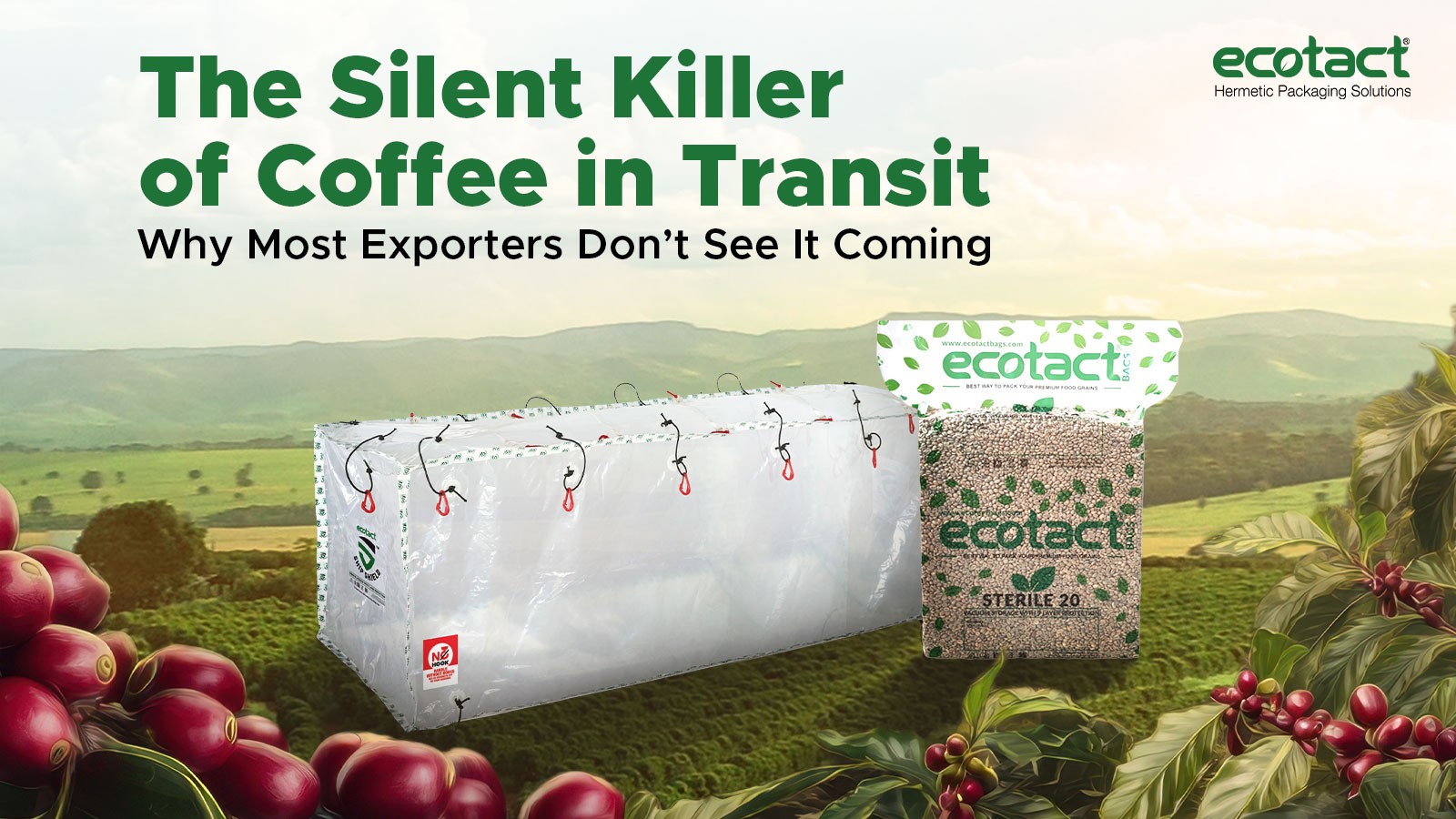
That’s where Ecotact steps in. Our 9-layer hermetic packaging is engineered like a vault for your beans, preserving their natural integrity from the moment they leave the drying station to the time they’re roasted.
We call it the Power of Zero*, and it’s exactly what every exporter wishes they had before their first shipment went wrong:
0% Oxygen Ingress: No oxidation, no staling, no loss of aroma.
0% Moisture Penetration: No dampness, mold, or fermentation.
0% Pest Infestation: No need for fumigation or chemicals.
0% Quality Loss: Your beans arrive exactly as you intended.
What’s more, these bags are recyclable, food-safe, and field-tested across different climates. They’re already being used globally by producers who see packaging not as an afterthought, but as the final step of quality control.
The Future of Coffee Exports Is Sealed
As global markets become more competitive, importers are demanding traceability and consistent cup profiles. That means it’s no longer enough to produce great coffee, you have to deliver it in great condition too.
A well-protected bean tells your story perfectly, whether it’s from the volcanic soils of Guatemala, the highlands of Ethiopia, or the estates of Karnataka. The integrity of flavour and consistency in delivering fresh, authentic, aromatic coffee becomes your signature.
The silent killer in transit isn’t the ocean or the weather; it’s the slow, invisible erosion of everything you worked for. And once you understand that, you’ll never pack your coffee the same way again, only the Ecotact way!